Book Launch and Discussion under the Gyanpath Series, Janapada Sampada Division, Indira Gandhi National Centre for the Arts. Samvet Auditorium, IGNCA, Janpath, New Delhi, 26 November 2026.
The Programme
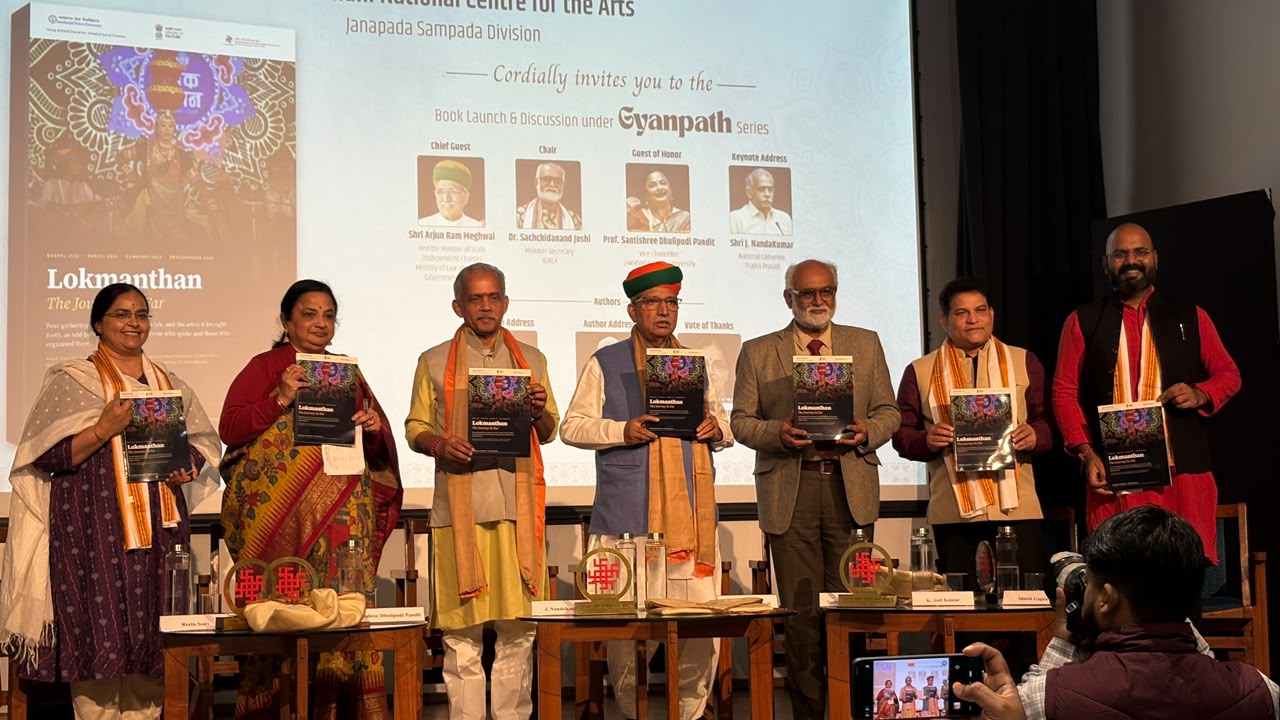
The Janapada Sampada Division of the Indira Gandhi National Centre for the Arts (IGNCA) held the release of ‘Lokmanthan: The Journey So Far’ on Samvidhan Divas, 26 November 2026, at the Samvet Auditorium, New Delhi, under its Gyanpath series, in association with the Ministry of Culture, Jawaharlal Nehru University and Prajna Pravah. Sh. Arjun Ram Meghwal, Union Minister of State (Independent Charge) for Law and Justice, released the book as Chief Guest. Sh. J. Nandakumar, National Convenor, Prajna Pravah, delivered the keynote address, Prof. Santishree Dhulipudi Pandit, Vice Chancellor, JNU, was the Guest of Honour, and Dr Sachchidanand Joshi, Member Secretary, IGNCA, chaired the programme. Prof. (Dr.) K. Anil Kumar, Head of the Janapada Sampada Division, welcomed the gathering, Dr Shubh Gupta, Assistant Professor, Group of Adult Education, JNU, presented the book, and Dr Reeta Sony A.L. of JNU proposed the vote of thanks. Research scholars, students, faculty members and practitioners filled the auditorium.
The Book and How It Was Made
The book, published by IGNCA and written by Dr Shubh Gupta, Dr Reeta Sony A.L. and Prof. (Dr.) K. Anil Kumar, with a foreword by Dr Sachchidanand Joshi and a message from Sh. J. Nandakumar, tells the story of the four Lokmanthan gatherings at Bhopal (2016), Ranchi (2018), Guwahati (2022) and Bhagyanagar (2024) in the words of those who attended, spoke at and organised them. Its 120 pages, in five parts and eighteen chapters with 168 photographs and figures, trace Lokmanthan from its first plans in 2014 to the fifth gathering at Jaipur.
The book is drawn from the full report of an impact evaluation, ‘Learning, Networks and Legacy: An Impact Evaluation of Lokmanthan, 2016 to 2024’, supported by the Janapada Sampada Division and submitted to it. Over about ten months, Revisit, a study circle of research scholars at JNU (Sh. Pranshu Pandey, Sh. Puneet Jha, Sh. Ankit Raj, Sushree Ranjana, Sushree Pranita, Sushree Priyanka, Sh. Adarsh Kumar Pandey and Sushree Gargi Pandey), visited the cities where Lokmanthan was held, administered a survey in Hindi and English that was answered by 219 respondents from about 2,300 registrations, and conducted and transcribed the interviews. Every account was checked against the published record of proceedings, addresses and press coverage.
The speakers interviewed include Sh. Rajiv Malhotra, Padma Shri Dr Kapil Tiwari, Sh. Umakant Gundecha, Dr Hindol Sengupta, Dr J. K. Bajaj, Swami Mitrananda, Prof. K. G. Suresh, Sh. Sudipto Sen, Sh. Manoj Shrivastava, Sushree Nayana Sahasrabuddhe, Sh. Sandeep Singh, Prof. Kaushal Panwar, Sh. Pawan Gupta, Sushree Shipra Pathak and Dr Kshama Kaul. Organisers and curators such as Sh. Deepak Sharma, Dr Mukesh Mishra, Sh. Sangeet Verma and Sushree Neha Tiwari were interviewed, along with practitioners Sushree Kamli Kushram, Sh. Jambu Singar and Sh. Ramesh Katara, who built the first exhibition at Bhopal, Sh. Kalamandalam Prasobh of the Kathakali tradition and Sushree Binita Devi, puppeteer of Guwahati. Sh. Sudipto Sen calls Lokmanthan “the only oasis in the desert of our existence”, and Sh. Rajiv Malhotra asks for conversations with those who hold the opposing view, so that each session becomes a true manthan.
Of those surveyed, 98 per cent say Lokmanthan strengthened their confidence in discussing from a Bharatiya point of view, 94 per cent carried the discussion into their own institutions, 97 per cent affirm the equal dignity of lok and scholarly knowledge, and 89 per cent report a relationship formed there that has continued. Respondents ask for Lokmanthan to be held more often and nearer home: 97 per cent want one held in their own state or district, and four in five would hold it every year. The book makes fifteen recommendations, among them yearly state and regional gatherings between national ones, a standing secretariat, a daily session in which a practitioner speaks on their own form, and a register of practitioners kept with the Janapada Sampada Division.
The Proceedings
In his keynote address, Sh. J. Nandakumar explained the central idea of Lokmanthan. Lok, he said, means the people of Bharat and manthan the churning of their thought. He described Lokmanthan as an intellectual mela that brings scholars and the bearers of living traditions together and gives knowledge carried in practice the same respect as knowledge preserved in texts. Since 2011, he said, the effort has been to free lok from the colonial label of “folk”, which divided the people of Bharat into “jungle dwellers” and “mountain dwellers”. Recalling Nanjiyamma, the janjatiya singer from Kerala who won the National Award for best female playback singer, he said the lok carries its own learning. Dharma, he said, unites people, and decolonisation is a continuing process.
Citing the Bhagavad Gita and Milan Kundera, Sh. Nandakumar said, “Memory is everything. If the memory is lost, everything is lost,” and added that Bharat can become a Viksit Bharat only when its civilisational memory is restored, so that the nation’s development carries that memory with it. Appreciating the young researchers, he said an impact study of Lokmanthan had long been needed and now exists. “The nation gives us everything; we must also learn to give something back,” he said, assuring support for further research. He announced the theme of the fifth Lokmanthan at Jaipur, ‘Hum Bharat Ke Log’, and urged everyone present to attend.
Releasing the book, Sh. Arjun Ram Meghwal greeted the audience on Samvidhan Divas and noted that the Constitution is now available in Bharatiya languages, including Santhali. Recalling being stopped at an airport because his Rajasthani dhoti and pagdi did not match the officials’ idea of a Member of Parliament, he said freeing the mind from such colonial habits is the real task of decolonisation. He recalled Sh. Jagannathrao Joshi’s reply in the Lok Sabha that Bharat was a nation long before the British came, and the example of Sh. N. C. Chatterjee, who named his son Somnath though he had never visited Somnath, as evidence of the strength of cultural memory. He urged scholars to use Bharatiya terms in their writing, said he would attend the Lokmanthan in Jaipur, and closed with a Rajasthani lok geet.
Presenting the book, Dr Shubh Gupta said the study began with a question he had put to Sh. J. Nandakumar, whether Lokmanthan reaches the consciousness of the people, and was entrusted to an independent group of JNU scholars to keep his own bias out. Lokmanthan, he said, is the churning of the lok, the people of Bharat, and the book evaluates it through the memories of those who took part. As a scholar of adult education he described Lokmanthan as a place of informal learning where janjatiya artists become teachers and a wall, a drum, a rangoli or a meal shared in one row becomes a site of learning. Cautioning against turning living traditions into museum pieces, he noted that the fifth Lokmanthan is being held in Jaipur as the city enters the 300th year of its foundation.
Prof. Santishree Dhulipudi Pandit described Lokmanthan as a grassroots cultural movement and said Bharat must be understood as a civilisational state whose history does not begin with independence. Calling for the revival of civilisational memory and the building of new narratives rooted in it, she said, “Political power is sustained by narrative power,” and urged young researchers to use terms such as dharma untranslated in their writing.
Figure 4. Prof. Santishree Dhulipudi Pandit (left) and Sh. Arjun Ram Meghwal (right) address the gathering.
In his presidential remarks, Dr Sachchidanand Joshi likened Lokmanthan to the gatherings of Naimisharanya and the Kumbh. Bharat sees time as cyclical, he said, narrating the story of Shri Ram’s ring found by Shri Hanuman among the rings of the Rams of earlier ages, and an impact study helps a society preserve the memory that carries it forward. Quoting Dr Vasudev Sharan Agrawal, he said lok becomes shastra and shastra returns to lok, and Lokmanthan keeps this cycle alive.
Dr Reeta Sony A.L., proposing the vote of thanks, recalled learning the meaning of lok from Sh. J. Nandakumar’s first book, spoke of her Banjara community, which carried its culture barefoot across the country, called Lokmanthan an epic, and closed the programme with a Kannada lok geet.
The Way Ahead
The release came eight days before the fifth Lokmanthan, on the theme ‘Hum Bharat Ke Log’, to be held at Jawahar Kala Kendra, Jaipur, from 4 to 6 December 2026. The book and its recommendations are placed before the organisers of Jaipur and of the gatherings to follow.