It is necessary for the citizens of the country to become free from a colonial mindset
Society across the country, including Andaman and Arunachal, is connecting with the Sangh
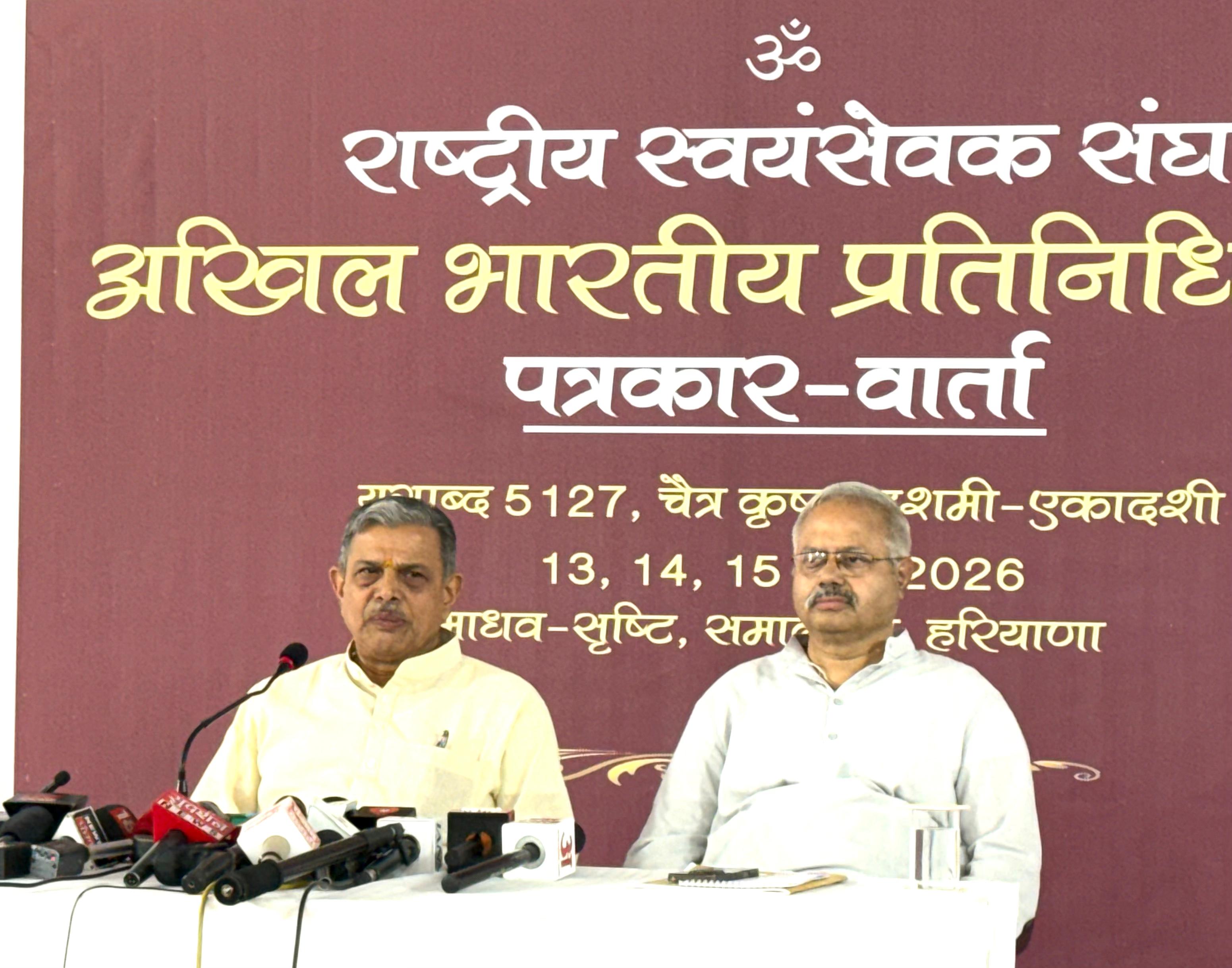
Samalkha (Panipat), 15 March 2026: The three-day Akhil Bharatiya Pratinidhi Sabha meeting of the Rashtriya Swayamsevak Sangh concluded with a resolve to expand organisational work, encourage greater active participation of the positive forces of society in national interest, and strengthen social harmony. On the final day of the meeting, RSS Sarkaryavah Dattatreya Hosabale Ji, interacted with journalists.
He said that there has been a significant expansion in organisational work over the past year. The number of Sangh shakhas has increased by nearly six thousand and has now crossed 88,000. The number of places where shakhas are conducted has also grown to more than 55,000. Along with this, the number of saptahik milans and mandalis has also increased. He added that organisational expansion should also be viewed in terms of the Sangh’s presence in regions such as Andaman, Arunachal Pradesh, Leh, and remote tribal areas, where shakhas are now being conducted. This organisational growth can also be clearly seen in the programmes related to the Sangh’s centenary year. In Andaman, more than 13,000 people from nine islands participated in a Hindu Sammelan, which was attended by the Sarsanghchalak Ji. Similarly, in a state like Arunachal Pradesh, which has a low population density, more than 37,000 people took part in 21 Swadharma Sammelans.
According to Sarkaryavah Ji along with organisational expansion, the Sangh is continuously working to enhance quality in society. Inspiring positive social change through the concept of Panch Parivartan is considered important. He said that being Bharatiya or Hindutva is not merely an idea but a way of life, and through this, the values and quality of society should expand. With this objective, it is necessary to bring together the positive and well-intentioned forces of society and encourage the Power of Good to work in the national interest.
He said that society should accept the work and contributions of great personalities by rising above divisions of caste and sect, and should move forward towards positive change through their inspiration. The 150th anniversary of the national song Vande Mataram was also celebrated with enthusiasm. He further said that programmes are being planned for the coming year to mark the 650th birth anniversary of Sant Shiromani Ravidas Ji Maharaj.
Providing details about the regular training camps planned for the coming year, Dattatreya Hosabale Ji said that a total of 96 training camps will be organised, including camps in 11 regions and one in Nagpur. He further stated that the Pratinidhi Sabha also deliberated on initiatives related to gau-seva and rural development. Citizens will be encouraged to grow vegetable gardens on their rooftops and use manure prepared from indigenous cows so that everyone can contribute meaningfully to gau-seva and sustainable village development. He further said that people can also take a pledge to build green homes (Harit Ghar) by making efforts such as minimising the use of polythene and promoting water conservation.
Responding to a question related to changes in the organisational structure of the Sangh, he said that decentralisation in the structure has been discussed. Under this proposal, smaller units called Sambhag may be created in place of Prant, and once implemented, there will be more than 80 Sambhags instead of the existing 46 Prants.
Answering another question, the Sarkaryavah Ji said that the media should also come forward to help eliminate caste-based divisions in society and stop assessing the number of voters on a caste basis during elections. He appreciated the diplomatic efforts being made by the country’s government in the national interest in the present international situation and said that the Sangh stands for peace and development in the world.
Responding to another question, he said that Dr. Hedgewar did not establish the Sangh in opposition to any community or form of worship. The second Sarsanghchalak, Shri Guruji, had also said that all people share common ancestors and that differences in methods of worship do not create divisions; although the term “DNA” was not used, the meaning was similar. The third Sarsanghchalak, Balasaheb Deoras, had likewise stated that all those who consider Bharat as their motherland and nation and live by the spirit of Bharatiyata are Hindus. He added that everyone is welcome in the Sangh, and anyone doing good work for society is regarded as a Sangh Swayamsevak.
Enthusiasm for the Sangh is visible in society across the country
In Andaman, more than 13,000 people from nine major islands participated in a Hindu Sammelan held in the presence of the Sarsanghchalak Ji. Similarly, in a state like Arunachal Pradesh, which has a low population density, more than 37,000 people took part in 21 Swadharma Sammelans.
Respect and emulate great personalities
The contributions of great personalities should be accepted by rising above divisions of caste and faith, and society should move towards positive change through their inspiration. In this spirit, Sangh swayamsevaks organised more than 2,000 programmes across the country on the occasion of the 350th martyrdom anniversary of the ninth Guru, Shri Guru Tegh Bahadur Ji, in which over seven lakh people participated.
Plan for decentralisation in the organisational structure
In the Akhil Bharatiya Pratinidhi Sabha meeting, along with the expansion of the Rashtriya Swayamsevak Sangh, discussions were also held on decentralising the organisational structure to improve the quality and ease of work.