World Water Day 2026: On water, gender, and the decisions that exclude both
Article By : Chaithanya Vishwamitra D.A
Every year, on March 22nd, the world celebrates World Water Day. Governments make announcements. Organizations post updates in blue. And March 23rd comes and goes. The taps don’t turn on in the villages. The women , Men still wake up before dawn to trek to the rivers. The girls still don’t go to school because someone has to fetch water back to the villages.
This is not a problem that the world doesn’t know about. This is a problem that the world has decided not to solve.
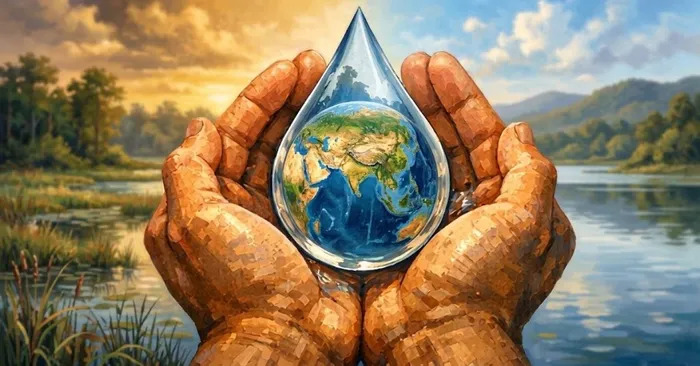
The theme for World Water Day 2026 is Water and Gender. The slogan for the campaign is simple yet powerful. It goes like this: “Where Water Flows, Equality Grows.” The Water Diplomat The United Nations is not using these words lightly. The UN World Water Development Report 2026, which goes by the title “Water for All People: Equal Rights and Opportunities,” was launched on the 19th of March 2026 at the United Nations Headquarters in New York. UN-Water
The underlying message behind the campaign for this year’s World Water Day is something that data has been saying for a while now, though policy has consistently ignored it.
More than 1 billion women or over 27 percent of all women on the planet do not have access to safely managed drinking water. World Bank This is not a number from a less-developed country. This is a number for the world. And it fits inside another number 2.1 billion people still lack access to safely managed drinking water services.
The burden of the shortage is unevenly shared. There are still 1.8 billion people worldwide who do not have drinking water available at home. In two out of three of these homes, the task of collecting the water is primarily the woman’s. UNSD This is the reality: A woman goes outside her home, walks to a source of water in some cases a long way, in all cases an unsafe way collects water in a container, and walks back. Every single day. In 53 countries across the world, where data is available, women and girls spend 250 million hours a day collecting water. That is more than three times the number of hours that men and boys spend collecting water. World Bank
Read that number again. Two hundred and fifty million hours. Every day. Not in one country. Not in one region. Across 53 countries. Measured. Verified.
Those 250 million hours are not just lost time; they are lost education, lost economic opportunity, and lost safety. Those 250 million hours are lost education. When a girl spends her morning fetching water, she will be late for school, or she will not go at all. Those 250 million hours are lost economic opportunity. When a woman spends her morning fetching water, she will not have time to build, trade, or lead. Those 250 million hours are lost safety. When a woman spends her morning fetching water, she will be vulnerable to harassment and violence on a long walk to a distant source of water. The water crisis is not just a health crisis; it is a crisis that drives some of the greatest gender inequality in the world.
And yet, despite being the people who are most impacted by this issue of water scarcity, women are almost entirely absent from the spaces where decisions are being made on this issue. In fact, some 14 percent of countries do not have a formal system in place that ensures women are equally represented in decision-making processes related to water management. World Bank The people who are carrying this problem are not sitting around the table where this solution is being determined.
India is a country that sits uncomfortably at a crossroads in this issue of water scarcity. India is the world’s largest consumer of groundwater, using some 241 billion cubic metres of groundwater every year, or more than a quarter of all groundwater withdrawn globally. The women of India’s countryside are the managers of their households’ water supplies. They are the people who know exactly where that borewell is drilled into the earth, exactly how long that pump is running, and exactly how many days of the month that tap is empty.
In total, unsafe water, bad sanitation, and bad hygiene practices combine to kill 1,000 children under the age of five each day. World Bank This is not kids dying from rare diseases or complicated conditions. This is kids dying from bad water. From the lack of something that costs less to fix than almost any other public health intervention on the face of the Earth.
The analysis draws to a close with a very obvious conclusion. The global water crisis and the global gender inequality crisis are not two separate crises. They are two crises that sustain each other. Water scarcity holds women back. And holding women back from water is holding back the solutions.
When women are in charge of water solutions, the research shows that water systems work better. This is not opinion. This is data.
The question that World Water Day 2026 poses is one that all governments, all cities, and all people need to answer truthfully: who decides where the water goes? If the answer is not the women who carry the water every morning, then the answer will always be an incomplete one.
Where water flows, equality grows. First, the water has to flow.