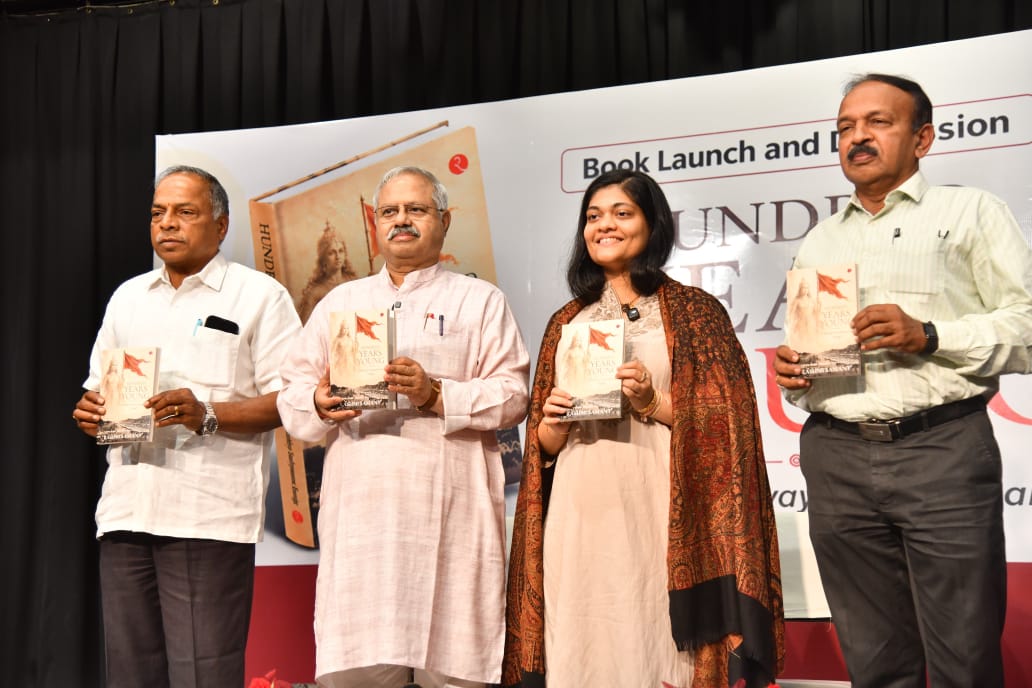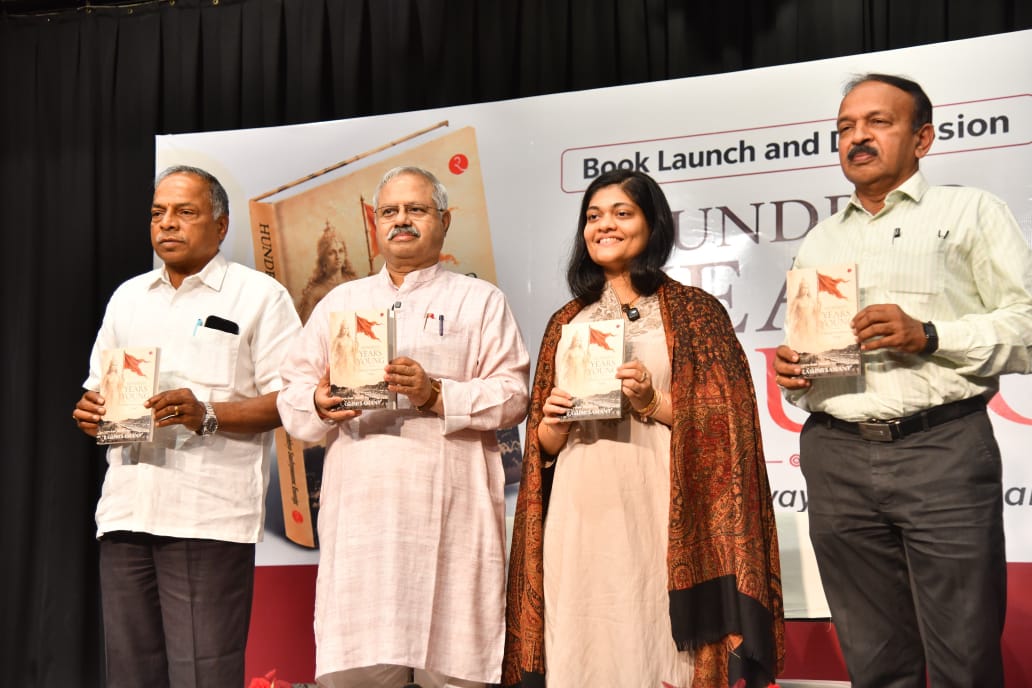
Bengaluru: November 17, 2026. “Hundred Years Young: Rashtriya Swayamsevak Sangh”brings together 18 chapters written by 20 young contributors from remarkably different walks of life. The collection deliberately moves beyond the familiar political and organisational vocabulary through which the RSS is often discussed. Instead, it examines the Sangh through personal experiences, professional journeys, cultural memory, social service, identity, sport, entrepreneurship, international relations and intergenerational inheritance, said author Rashmi Samant at the launch of the book Hundred Years Young Rashtriya Swayamsevak Sangh at Bharatiya Vidya Bhavan, Bengaluru.
Speaking on her book Rashmi Samant said “The contributors are not a homogeneous group of organisational voices. They include a Muslim woman journalist, a queer Hindu activist, a British political analyst, an Israeli researcher, a German-based Indian elected representative, a celebrated sportsperson, a filmmaker and entertainment entrepreneur, a Bollywood actor, a Kashmiri Pandit, a national-level basketball player, a young education entrepreneur and several professionals whose lives have been shaped by direct or indirect encounters with the Sangh.”
“The result is a collection of individual human stories rather than one uniform institutional narrative” she added.
The contributors: who they are and what they bring to the book
- Adhitya Srinivasan – Internationally trained lawyer and Supreme Court litigator: Draws on his journey from a cosmopolitan upbringing in the Middle East to discovering the Sangh, highlighting discipline, personal responsibility, perseverance and leadership through example.
- Vijay Subramaniam – Founder and Group CEO of Collective Artists Network: Examines the RSS through the lens of cinema, storytelling and popular culture, arguing that the Sangh has helped preserve Bharat’s civilisational memory and cultural confidence.
- Rahul Kumar Kamboj – First person of Indian origin elected to Frankfurt’s city parliament: Explores how Indians living abroad can retain their civilisational identity and contribute to India’s global standing through community, organisation and seva.
- Vikrant Massey – National Film Award-winning actor: Looks beyond political perceptions to the Sangh’s grassroots work in education, healthcare, disaster relief and rural communities, presenting seva as a lived commitment to human dignity.
- Rubika Liyaquat – Award-winning Muslim journalist and television anchor: Recounts her journey from childhood apprehensions about the RSS in a Muslim household to a more informed understanding through personal encounters and observation.
- Ankit Bhuptani – Queer Hindu activist and voice for LGBTQ inclusion: Challenges the assumption that LGBTQ advocacy must be opposed to traditional or nationalist institutions, making a case for dialogue, indigenous frameworks and inclusion within India’s civilisational traditions.
- Chris Blackburn – British political and security analyst: Offers a European liberal’s perspective on the RSS, examining its historical origins, civilisational response and evolution beyond the political labels commonly applied to it.
- Rashmi Samant – Oxford-educated author and former Oxford Students’ Union President: Presents the personal perspective of a daughter of a swayamsevak, reflecting on how growing up alongside her father’s quiet commitment shaped her understanding of duty, service, discipline and inheritance.
- Yeshaya Rosenman and Matanel Lottner – Israeli journalist-researcher and researcher of Sanskrit, Indian philosophy and comparative religion: Draw parallels between Jewish and Indian civilisational experiences, exploring how societies can pursue progress without abandoning historical memory and cultural continuity.
- Vishesh Bhriguvanshi – Arjuna Award-winning former captain of the Indian national basketball team: Connects the discipline and teamwork he observed in shakha with his sporting journey, reflecting on how everyday consistency and collective responsibility shape individual character.
- Yaduveer Krishnadatta Chamaraja Wadiyar – Scion of the Mysuru royal family and public representative: Examines the relationship between the Sangh, social welfare and the Mysuru legacy of public service, emphasising leadership as responsibility towards society.
- Brinda Kotak – Young contributor reflecting on personal experiences of the Sangh: Explores the quiet influence of resilience, belonging and the values absorbed through the Sangh’s ecosystem in shaping personal character.
- Yuvraj and Yashraj Bhardwaj – Young entrepreneurs and founders: Through From Shakha to Startups, explore the relationship between organisational discipline, problem-solving, entrepreneurship and building institutions that serve a larger purpose.
- Sharad Vivek Sagar – Social entrepreneur and founder of Dexterity Global: Connects the teachings of Swami Vivekananda, the Sangh’s emphasis on character-building and his own journey of creating opportunities for young people from underserved backgrounds.
- Bhasha Sumbli – Kashmiri Pandit actor and writer: Shares the experience of growing up as a child of exile, reflecting on displacement, cultural survival, memory and the importance of community support in rebuilding lives.
- Nikhil Chandwani – Social entrepreneur and contributor to refugee rehabilitation: Reflects on his work with displaced Hindu and Sikh families from Sindh, showing how service, rehabilitation and restoring dignity to forgotten communities give practical meaning to national responsibility.
- Rishabh Shah – Founder and President of I.I.M.U.N., a youth-led international organisation: Reflects on his interactions with the Sangh and its workers, drawing lessons on institution-building, patience, leadership, dialogue and the importance of putting the collective ahead of oneself.
- Saina Nehwal – Olympic medallist, former World No. 1 and internationally acclaimed badminton champion: Connects the idea of man-making with the discipline, perseverance and character required to produce sporting excellence, drawing parallels between personal development and nation-building.
Institutional perspectives
- Param Pujaniya Dr Mohan Bhagwat – Sarsanghchalak, RSS: In his special message, reflects on a century of character-building, selfless service and the continuing effort to become better swayamsevaks.
- Shri Sunil Ambekar – Akhil Bharatiya Prachar Pramukh, RSS: In the foreword, places the centenary in the context of India’s civilisational confidence, youth leadership, social cohesion and the long-term project of nation-building.
What makes this collection distinctive?
The diversity is not merely in the contributors’ professions or biographies. It is in the different vantage points from which they approach the same institution. - From within families: The inherited experiences of Adhitya Srinivasan and Rashmi Samant.
- From outside India: The perspectives of Rahul Kumar Kamboj, Chris Blackburn, Yeshaya Rosenman and Matanel Lottner.
- Across religious and identity backgrounds: Rubika Liyaquat, Ankit Bhuptani and Bhasha Sumbli.
- Through popular culture: Vijay Subramaniam and Vikrant Massey.
- Through sport: Saina Nehwal and Vishesh Bhriguvanshi.
- Through entrepreneurship and youth development: Yuvraj and Yashraj Bhardwaj, Sharad Vivek Sagar and Rishabh Shah.
- Through public service and social responsibility: Yaduveer Wadiyar, Brinda Kotak and Nikhil Chandwani.
The central editorial idea: Rather than asking 20 young achievers to tell the same story about the RSS, the book invites them to tell their own stories of encountering, observing, questioning or experiencing it. Some write from personal inheritance, some from professional experience, some from outside the country, and others from backgrounds that might not ordinarily be associated with the Sangh.
“Together, these accounts offer multiple human perspectives on a hundred-year-old institution. They are not intended to be one unanimous voice, but a conversation across generations, professions, nationalities and identities.” said Rashmi Samant.
RSS Akhil Bharatiya Prachar Pramukh Sunil Ambekar launched the book Hundred Years Young Rashtriya Swayamsevak Sangh at Bengaluru along with Rashmi Samant, RSS Kshetreeya Karyavah N Tippeswamy, RSS Prant Karyavah Dr M Jayaprakash.