April 17, 2026, Stanford University, California, USA
- 1. Thanks to the Global Science and Innovation Forum for bringing us together and creating this space for dialogue.
- 2. The purpose in being here is to share knowledge from Indian civilization and to learn from the rest of the world.
- 3. In our Indic tradition, there is no separation between spiritual and scientific knowledge; both are seen as parts of one whole.
- 4. Texts like the Upanishads present human anatomy, mind, action and inaction, perception and beyond, not merely devotional content.
- 5. Over centuries, scientific ideas were preserved inside spiritual texts, so later generations often missed their scientific dimension.
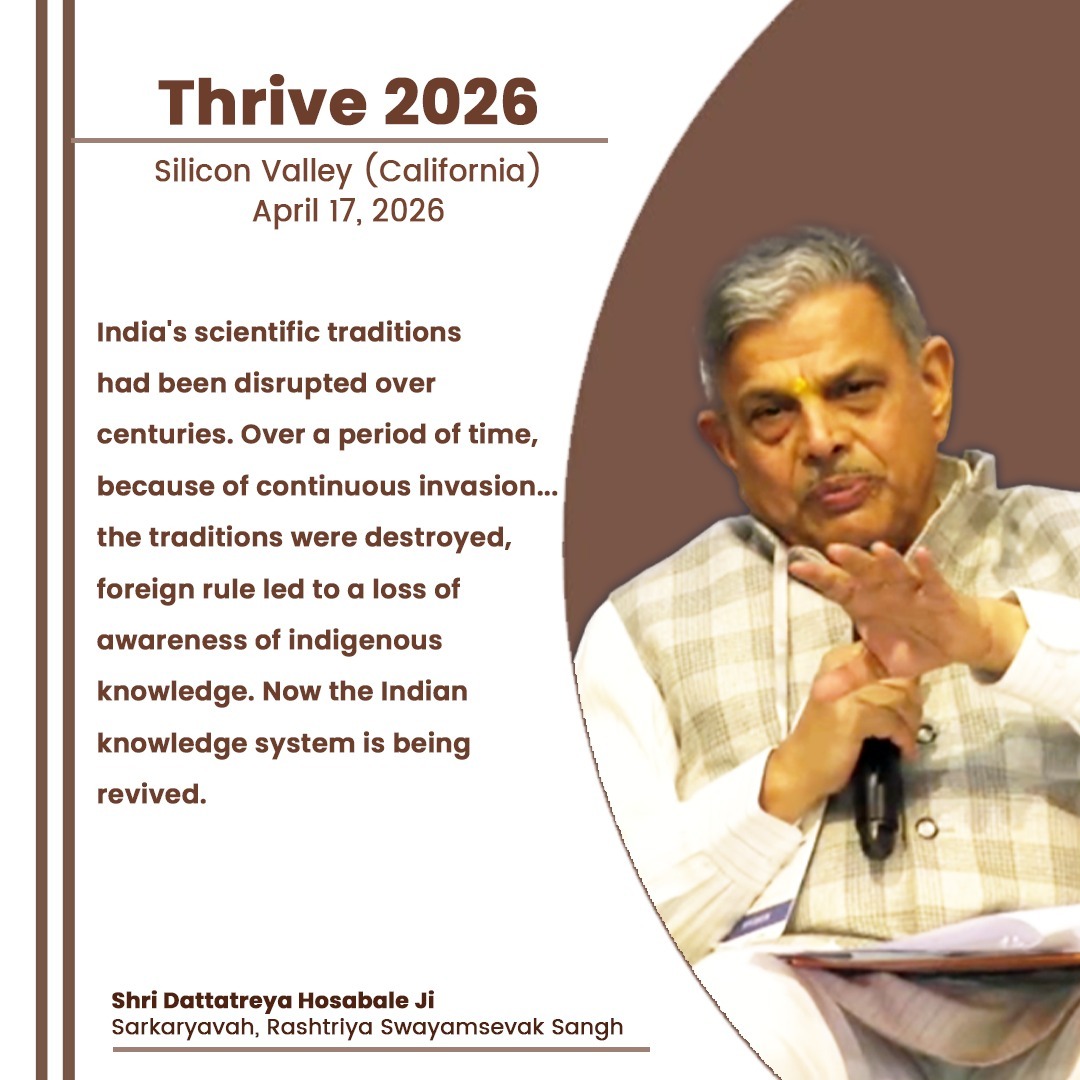
- 6. Foreign invasions and long periods of foreign rule led to serious damage to institutions and traditions, and much of this knowledge was suppressed or forgotten.
- 7. Today, a new education policy in India is attempting to revive the Indic knowledge system in a modern, systematic way.
- 8. For nearly a thousand years, people here were made to forget their own scientific heritage and intellectual traditions.
- 9. The civilizational heritage includes a deep habit of cosmic enquiry – questions about space, the cosmos, the link between microcosm and macrocosm.
- 10. Historically, there were planned cities, universities, and advanced civil engineering, all of which presupposed high material and scientific understanding.
- 11. The traditional scientific attitude is to understand nature, use it wisely, and protect it at the same time, not to exploit it.
- 12. Education is central to shaping society and ensuring that science and knowledge serve all of humanity.
- 13. In this view, scientific inquiry and spirituality are not two opposing forces; they support and enrich each other.
- 14. Historically, the same scholars and practitioners often engaged in both scientific research and spiritual practice, integrating dharma, civilization, and wisdom.
- 15. Both legal frameworks and scientific systems are meant to secure life, livelihood, and everyday well-being for people.
- 16. When technology races ahead while parts of society lag in education, the result is growing inequality.
- 17. Economic growth, educational access, and quality of life are deeply interlinked; progress in one affects the others.
- 18. On one side, inequalities, prejudices, and superstitions must be addressed; on the other, scientific advancement must be pursued.
- 19. If the education system does not convey the scientific outlook within tradition, then the scientific achievements of the past get dismissed as mere superstition.
- 20. There is a real challenge: to separate genuine science from superstition, which requires serious social and intellectual effort.For this reason, the Indic knowledge system is now being placed in the forefront, so that this heritage can be critically revived and integrated.
- 21. Humility grows from the understanding that all beings arise from one original source of energy.
- 22. When nature is treated as a slave, existing only to satisfy human needs and greed, exploitation naturally follows.
- 23. The Hindu tradition teaches respect for every creature, seeing the same energy or divinity in oneself, in others, and in all flora and fauna.
- 24. This sense of universal oneness leads to respect, humility, and a view of the entire universe as one interconnected whole.
- 25. The democratization of knowledge is essential; knowledge is being created, but it does not yet flow freely to everyone.
- 26. True democratization means that knowledge from all communities, nations, and civilizations should be accessible to all, placing people on a more equal footing.
- 27. Any technology intended for human welfare should be tested on three touchstones: economy, ecology, and ethics.
- 28. Technologies that create economic inequality, exploit nature, or break ethical norms ultimately damage society and the environment.
- 29. In this tradition, jnana (knowledge) must be guided by viveka (wisdom, rational discrimination) to ensure responsible use.
- 30. Knowledge without wisdom generates ego and arrogance, while knowledge combined with viveka becomes truly beneficial to both the individual and humanity.